Why Pregnancy Is Counted From Your Last Period, Not Conception
Why pregnancy weeks start from the first day of the last period, even though conception usually happens later.

One of the oddest things about pregnancy dating is that you can be described as two weeks pregnant before conception has happened. For people encountering this for the first time, it can feel like a mistake. It is not. It is the standard medical way of counting gestational age.
Pregnancy is usually dated from the first day of the last menstrual period, often shortened to LMP. This is not because clinicians believe conception happened on that day. It is because the first day of a period is usually easier to identify than the exact day an egg was fertilised.
The basic timeline
In a typical cycle, the first day of bleeding is called day 1. Ovulation often happens around two weeks later, though real cycles vary. Fertilisation can happen around ovulation if sperm and egg meet. Implantation happens later still.
Medical pregnancy weeks begin at day 1 of the last period. So by the time fertilisation happens, gestational age is often around 2 weeks. By the time a home test becomes positive, gestational age may already be around 4 weeks.
This is why an app may say 4 weeks pregnant shortly after a missed period. It is using gestational age, not counting from the moment of conception.
Why not count from conception?
The exact day of conception is often unknown. Sperm can survive for several days, ovulation does not always happen on the same cycle day, and fertilisation itself is not something most people can observe. Even when someone knows the day they had sex, that does not prove the exact date conception occurred.
The first day of the last period is a clearer starting point for many people. It gives clinicians a shared method for estimating pregnancy stage, arranging scans and discussing care.
The method is not perfect. It is an estimate based on a typical cycle. That is why an early ultrasound may later confirm or refine the dates.
Gestational age and fetal age
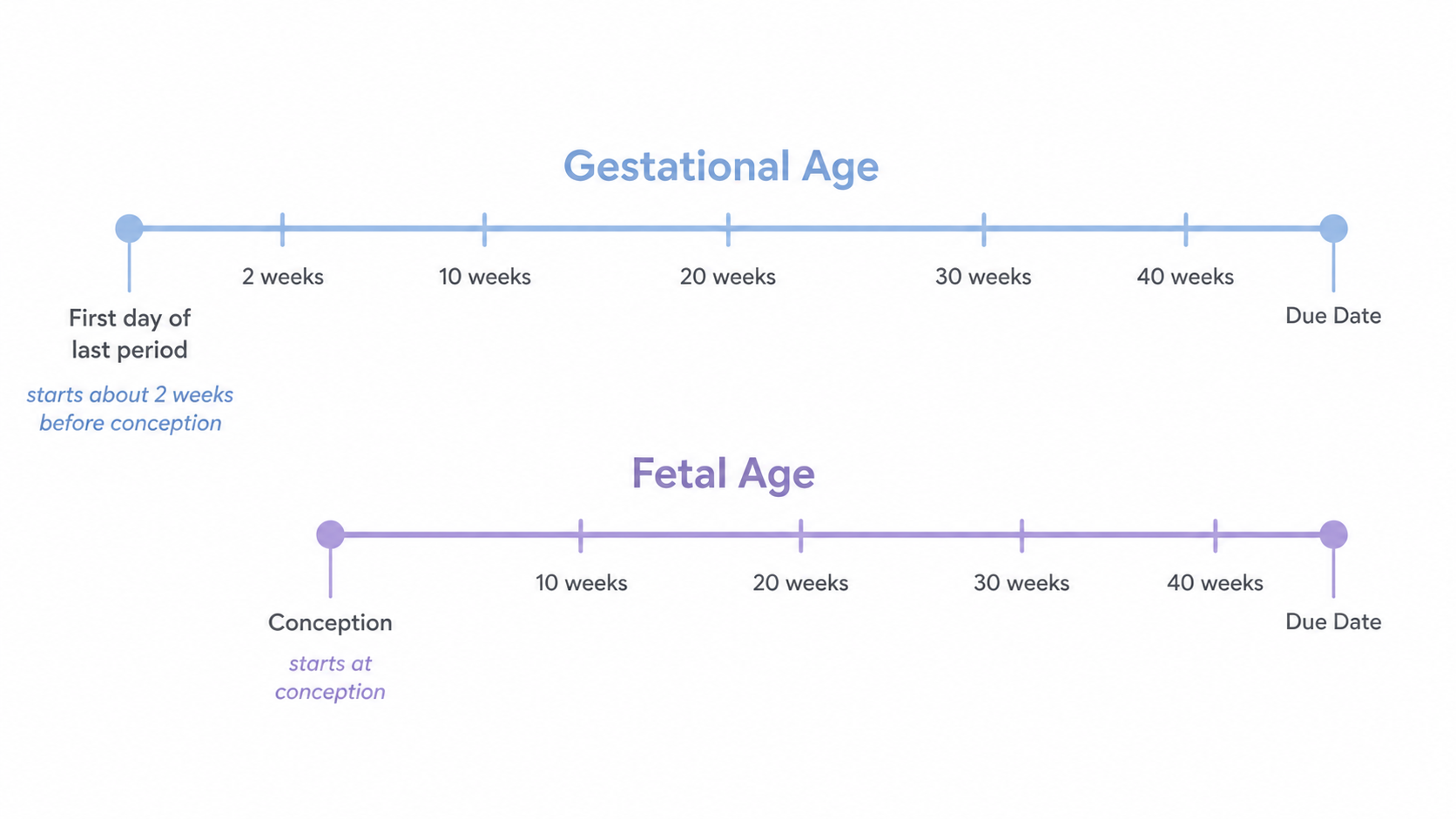
Two related terms can cause confusion. Gestational age is the standard pregnancy-week count from the last period. Fetal or embryonic age describes development from fertilisation and is usually about two weeks less than gestational age in a typical cycle.
For example, at 10 weeks pregnant by gestational age, the embryo or fetus has usually been developing for around 8 weeks. Both numbers can be correct. They are simply counting from different starting points.
Most appointment notes, scan reports and pregnancy apps use gestational age. That is the number you will usually see written as 10+4, 12 weeks, or similar.
What if your cycles are not regular?
The last-period method works best when cycles are fairly regular and ovulation happens close to the expected time. If cycles are long, short, irregular or recently affected by contraception, breastfeeding, illness or other factors, the estimate may be less precise.
That does not mean you did anything wrong by entering your LMP. It simply means the initial calculation is a starting point. A dating scan can give your care team more information about the pregnancy timeline.
If you know a likely conception date, you can use a conception-date calculator as another estimate. It may be helpful, especially when periods are irregular. Still, your clinic may use scan information as the main reference once it is available.
Why scans can change the date
An early scan measures development and compares it with expected ranges. If the scan estimate differs enough from the LMP estimate, the care team may update the due date or pregnancy week. This is not usually a sign that something has gone wrong. It often reflects the fact that ovulation did not happen on the textbook day assumed by a period-based calculation.
Once a clinic has given you a main estimated due date, it is usually less stressful to use that date consistently. Switching between several dates can make ordinary differences feel larger than they are.
IVF is different, but uses the same language
With IVF, fertilisation and embryo age are known. Clinics can calculate pregnancy timing from transfer date and embryo age with more precision than a standard LMP estimate. Even then, the resulting timeline is expressed as gestational age, so it fits the same pregnancy-week system used everywhere else.
This is why a day-5 embryo transfer is counted as 2 weeks and 5 days pregnant on transfer day. The calculation is based on a known embryo age but translated into the standard clinical language.
A practical example
Imagine your last period began on 1 January. A standard calculator may estimate ovulation and conception around 15 January. It will call 1 January 0 weeks and 0 days. On 15 January, it will call you 2 weeks pregnant. By 29 January, it will call you 4 weeks pregnant, even though conception was only around two weeks earlier.
That is not an attempt to rewrite your experience. It is simply the established dating convention.
How to use this information without overthinking it
The simplest approach is:
- Use the first day of your last period for an early estimate if you know it.
- Use a conception date only if it is genuinely known or likely more useful for your situation.
- Treat an early scan and your care team’s dating as the main clinical reference when available.
- Remember that a due date is still an estimate, not a guaranteed birthday.
You do not need to calculate every stage yourself. A due-date calculator can do the date arithmetic, while your maternity team can explain what a scan means for your individual timeline.
The important takeaway
Pregnancy is counted from the last period because it is a practical, shared starting point, not because conception is thought to happen during a period. It allows clinics to talk consistently about weeks, scans and due dates when the exact conception date may be uncertain.
Once you understand that one convention, many confusing parts of pregnancy apps and scan reports make more sense. The week number is not trying to tell you exactly how long an embryo has existed. It is telling you where you are on the standard clinical pregnancy timeline.
Try the calculators
More in Pregnancy weeks
 Pregnancy Weeks vs Months: Why the Numbers Never Match Perfectly10 September 2026
 Understanding Trimester Boundaries: Where One Stage Ends and Another Begins24 July 2026
 Gestational Age vs Fetal Age: Why They’re Different23 July 2026